Showing posts with label Italian. Show all posts

Tuesday, October 9, 2012

vegetarian decadence

I've been absent for several months, with really no good reason other than my own selfish ennui. J developed some stomach issues, and with that came cooking complication.  All of the sudden onions, garlic, tomatoes, peppers, alcohol, vinegar, beans, and pretty much anything spicy came off the shopping list. I was flummoxed, and instead of rising to the occasion, I subjected both of our palates all summer long to plain grilled meats, fish, and veggies. Plain rice and potatoes dominated the starch category. No squeeze of lemon or fresh garden tomatoes welcome. I met a new challenge and I folded. I'm ashamed.

That said, with some diligence and a bit of medical science he is on the road back to being able to eat a wider variety of foods, with just a few adjustments. I've discovered that many of the verboten ingredients lose some of their ferocious kick with long simmering and a judicious hand. "Hot" is still out, but I have found ways to spice things up on my own food without assaulting J's stomach and his peace of mind. My first leap into the abyss started with a wonderful vegetarian lasagna featuring tomatoes, eggplants and herbs from the late summer garden. I had to buy zucchinis and squash. As quickly as our crop came, it disappeared.
zucs, squash, and mushrooms get diced for the filling--
in the small bowl are some diced eggplants, salted to remove moisture
I constructed the sauce from garden tomatoes, simmered whole to remove moisture and loosen the skins, then passed through the coarse disc on a food mill, to eliminate seeds, skins, and cores. A food mill is an inexpensive and handy tool to have when you want to separate out the bad stuff and keep the good stuff.
with a food mill, the pulp and juice pass through the holes, 
while the seeds, skins, and stems stay behind

The sauce is lightly cooked tomatoes, salt, garlic, a bit of
red pepper flake, and fresh basil

To mellow the garlic even more than it would during baking, I have used the trick of microwaving a few cloves on high for 15 seconds. The resulting steam partially cooks the garlic, and as a bonus, makes the skins slip right off. I limited the red pepper flakes to just a couple of pinches--very little in the overall scheme of ingredients.

While the sauce flavors melded, I squeezed the eggplant dry, and very gently sauteed all of the veggies in a splash of olive oil. The idea is not to brown the veggies, but to significantly reduce their moisture. Ordinarily I would have added a chopped onion and bell pepper as well to this mixture, and I suggest you do. I just didn't want to push things too far on this first foray into the forbidden foods.
the idea here is a significant reduction of the moisture in the veggies

once the veggies were done, I wilted a bag of baby spinach, cooked with
a tablespoon or so of dried shallots--for some onion flavor without
the volatile compounds
Once the spinach is wilted, wrap it in a kitchen towel and wring the bejeezus out of it, to remove as much moisture as possible. Vegetable liquids in a lasagna = watery, unappetizing fare.
veggies are combined and allowed to cool for assembly

I have read in Cooks Illustrated on several occasions that cottage cheese is superior to ricotta in lasagna--it doesn't become grainy, adds a bit of tang, and adds some welcome creaminess. All right, I'll bite. I gave it a shot. Whole milk or 2% cottage cheese combined with a cup of cream, and a cup of shredded parmesan. An added teaspoon of corn starch will help everything stay thick in the final dish. I added some lemon zest for brightness without acid, and a grating of nutmeg for some warmth. Then I grated some mozzarella and prepared for assembly.
the addition of cornstarch to the cottage cheese mixture
ramps up the creamy texture
I strongly recommend grating your own mozzarella. The pre-shredded stuff is treated to prevent clumping, which will also affect the gooey quality of the cheese in the baked dish. Squeeze the balls of mozzeralla--the softer they feel, the less rubbery the cheese will be. I tend to prefer Polly-O cheese, found usually near the shredded cheeses, though I have found that cheese quality varies by brand through different regions. Partially freezing the cheese before grating makes grating easier.

assembly--sauce, Barilla no-boil lasagna noodles, veggies, mozzarella,
and cottage cheese

I really love Barilla no-boil lasagna noodles. They are hassle-free, come out very similar to home-made noodles, and absorb any excess moisture in the lasagna. Start with a third of the sauce in a pan coated with non-stick spray. Add a layer of noodles, half of the veg, a generous sprinkle of mozzarella, and half the cottage cheese mixture. Repeat. Finish with a layer of noodles, the remaining sauce, and a layer of mozzarella.

I made two--a small one for our dinner, and a larger one
for the freezer, and a later informal dinner with friends

Cover both pans with foil sprayed with non-stick spray, and pop one in the freezer wrapped in a layer of plastic wrap, if you are making two, which is a great idea for an easy meal down the road. The one you are eating now can go into a 375 oven for about 40 minutes, or until bubbly. Remove the foil, and bake for another 15 minutes, or until the cheese begins to turn golden.

a fifteen minute rest, and it is ready to serve with a little garlic toast
and a sprinkling of fresh basil
I love this dish for several reasons. It is loaded with vegetables, delicious to eat, pretty to look at, and satisfyingly simple. I also love that it can be made ahead, and popped in the fridge or freezer for later baking.
I can clean up the kitchen before dinner, which means relaxing after dinner, and it is hearty enough vegetarian fare for even the most carnivorous of diners.


Friday, December 16, 2011

viva pepperoni!

I am a big fan of Top Chef, which may be a "duh" sort of statement, since I am obsessed with cooking, and that is the best cooking show on TV.  I was thinking about something new to cook for dinner the other day, and an episode from last season popped into my head.  Mike Isabella had made a sauce with pepperoni that had everyone excited.  I thought I would give it a go, adding shredded chicken and serving it over pasta.

For two people, I sweated about three ounces of pepperoni in a skillet over low heat, just until it gave up its fat and began to crisp.  Then I added some sliced mushrooms, red pepper flakes, sliced garlic, and a bit of salt, cooking them until they were fragrant.
the pepperoni didn't give off a lot of fat, so I just
used what was in the pan to saute the mushrooms and garlic--
if there had been more fat, I would have drained off 
all but a teaspoon or so


Into that fragrant concoction, I added a 14 ounce can of diced tomatoes, breaking them up a bit with a fork, thinning them with a bit of chicken broth, and bringing them up to a simmer.  It was a great medium for poaching a chicken breast.  I added the breast whole, to make sure it cooked gently, and didn't dry out; turning it a few times as it cooked, which took about 20 minutes.
white chicken meat is very lean and dries out quickly--
it should be cooked with gentle heat, just until done

After the chicken breast was cooked through, I pulled it out, shredded it with a couple of forks, and tossed it back in the sauce, simmering everything for a few minutes to combine the flavors while my pasta finished cooking.  
This is a hearty sauce, perfect for a satisfying winter meal,
relatively low in fat, and high in lipocenes from the tomatoes

adding the barely al-dente pasta to the sauce to finish cooking it
will combine the flavors and help the sauce cling to the pasta

Adding a bit of Parmesan and chopped parsley to the dish brightens everything up, and adds a fresh dimension of flavor.
the end result--another one of my favorite outcomes--
a full meal from one pan (okay, two--one for sauce, one for pasta)

I've come to realize that I tend to sprinkle fresh herbs on many of my finished dishes.  Usually parsley, basil, or cilantro; sometimes chives or chopped sage, maybe some fennel fronds or even celery leaves.   The finishing herb dusting has become a bit of a no-no in high-end chef circles, but I am not a chef, high-end or any other sort.  I like the brightness fresh herbs bring to the dish, in both color and flavor.  They add some nutritional value, and make food look more appealing.  My rules are to not get too carried away, and to make sure the herb compliments the food underneath it.  So I am going to continue to sprinkle away, whether Gordon Ramsey wants me to or not...


Friday, November 18, 2011

baked ziti, really?

Jim was browsing through a Cook's Illustrated magazine I had out on the kitchen table, when he spotted a recipe for baked ziti that he wanted me to make.  Really?  Baked ziti?  The only memory I had of baked ziti usually involved some awful Italianesque buffet table, sporting a dish with mushy, over-cooked pasta coated in dried-out sauce, and topped with a rubbery coat of cheese.  No thanks.  But, the magazine article swore it fixed all of those problems, so I thought, "Why not give it a whirl?"

The basic recipe included both tomato sauce and diced tomatoes, cottage cheese rather than ricotta, garlic, fresh basil, heavy cream, oregano, mozzarella, and Parmesan.  Along with ziti, of course.  I didn't have any ziti, but I did have penne, and plenty of it, so I used that instead.  Jim likes some meat in most of his meals, so I added in some browned hot Italian sausage.

The recipe called for creamy cottage cheese, which is often labeled "country style".  That gets combined with a couple of eggs.
cottage cheese?  I'll give it a whirl--whisked up here with two eggs


The sauce involved sauteing the garlic, adding both tomato sauce and diced tomatoes, oregano, black pepper, and a bit of sugar to highlight the tomato flavor.  I had a few late season tomatoes hanging about on the counter, so I chopped those up as well, and added some sausage I had cooked off earlier.
so far so good--the sauce was nicely balanced.  I added
the fresh basil at the last minute

While the sauce simmered for a few minutes, I whisked a teaspoon of cornstarch into the heavy cream, and cooked that until it had thickened.  Then that is stirred into the cottage cheese mixture.  The pasta gets boiled for about half the normal cook time, so it is VERY al dente.
mozzeralla gets cubed--easier to do if it goes into the freezer for 
half an hour

Once the pasta is cooked, some of everything gets combined in the pasta pot--the pasta, a cup of the tomato sauce, half of the mozzarella, and the cottage cheese.
not particularly appetizing to look at at this stage, 
though it was very creamy
That mixture gets put into a casserole, topped with the remaining tomato sauce, and dotted with the remaining mozzarella, along with a generous grating of parm.  It is then covered with foil and baked for about 30 minutes.
30 minutes in the oven, then the foil comes off


30 minutes more, and the top is crisp and brown

the final dish, after a 20 minute rest, was quite tasty


Okay, so it was good.  But it was complex to prepare, along the lines of a good lasagna in terms of steps and pots, pans, bowls, and mess.  Like lasagna, it can be prepared ahead, and the kitchen mess tackled well ahead of dinner, but if I am going to go to that much trouble, I think I will stick with the more complex and versatile lasagnas I make.   It made a lot.  So we have an uncooked pan in the freezer.  I'll be interested to see how it is after a stint in cold storage...


Thursday, June 9, 2011

lasagna!

I love a good lasagna.  I have never made one that didn't have loads of cheese, including mozzarella and creamy ricotta.  But I had some mushrooms and fresh local tomatoes that needed using, and I thought I would try a different tack.  A lasagna made with a white sauce and a creamy mushroom tomato sauce.

First things first.  The tomato sauce.  I sliced some green garlic from a local farm very finely on my hand-held mandolin, then sliced onions,cremini  mushrooms and sweet bell peppers.  Fresh thyme, oregano, and parsley rounded out the sauce flavors, along with some salt and pepper.
"green" garlic isn't really green -- it simply hasn't dried out yet --
the farmer from Red Fern farm gave me some uncured garlic --
she grows six different varieties

I sauteed the garlic, onions, peppers, and mushrooms, then added chopped, fresh, local tomatoes.   I also added some dried wild mushrooms hydrated in a bit of water, for a little interest.  I wanted some body in the sauce, so I went to the fridge for tomato paste, and didn't have any.  No worries.  I hydrated some sun-dried tomatoes in a little hot water, and ground them to a paste in a blender.  Last in the pot -- a bit of chopped thyme, oregano, and parsley from the garden.
a couple tablespoons of cream enriched the vegetable-laden sauce

I put the finished sauce in a bowl, and rinsed out the pan to make the white sauce.  No sense in making more of a mess than necessary.  A white sauce is a simple affair.  Equal parts butter and flour, cooked into a paste.  I used about four tablespoons each, and cooked them together for about five minutes.  I added salt, pepper, and some freshly grated nutmeg, then slowly added about 3 cups of milk I had heated in the microwave.  Once all of the milk was incorporated, and the sauce was smooth, I added about one and one half cups of grated Parmesan I had in the fridge.  

From there, it was simply assembly time.  I am a huge fan of Barilla's "no boil" lasagna noodles.  No pre-cooking necessary, and the baked noodles taste very similar to home-made pasta.  A layer of tomato sauce to prevent sticking in the bottom of the pan, then a layer of noodles, another layer of tomato sauce, a layer of white sauce (bechamel), noodles, tomato sauce, bechamel, noodles, sauce, bechamel.... you get the picture.  Once the casserole dish was full, I topped it off with a bit of grated mozzarella and my last bit of grated parm, covered it with foil, and baked it for about 45 minutes.
one of the things I love about lasagna -- nearly all of the kitchen
cleanup can be done while it bakes

Forty-five minutes in the oven, another twenty minutes without foil, and a ten minute rest out of the oven produces a perfectly golden dish of cheesy goodness.  You can certainly add meat, but in this case, I didn't think it was necessary.  A bowl of crisp salad, some crunchy grilled garlic bread...  Yum...

Friday, April 1, 2011

eggplant revisited

Jim really likes eggplant Parmesan.  I really hate making it because it makes such a mess.  The eggplant has to be battered with flour and egg, then breaded with some sort of crumb.  Then they have to be fried.  A sauce has to be made, then the whole thing layered up and baked.  I have to admit that it is tasty, and the kitchen can be cleaned up while it bakes, but I am not motivated to make it very often.

So I decided to try and reign in the multiple steps a little, at least for mess.  This time I did have motivation.  I had a refrigerator full of odds and ends vegetables, half a jar of spaghetti sauce, half a ball of fresh mozzarella, and an eggplant.  I decided to try breading and baking the eggplant instead of frying.  Still a process that created some mess, but the dishes for the breading could go in the dishwasher, and the top of the stove wouldn't be an oily mess.  I skipped the initial dip in flour, which helps the crust adhere during frying, and simply coated the eggplant in egg with a little milk and pressed it into seasoned panko breadcrumbs.
I seasoned the panko with salt, pepper, and fresh oregano;
the oregano in my garden is growing like crazy

I sprayed the crumbed eggplant with a spritz of olive oil (easier and more even than drizzling, so I keep a spray bottle of olive oil on hand).  
it baked up brown and crisp -- success without the mess

Yes, I had a jar of pasta sauce in my fridge.  I usually make my own sauce, but this stuff is good, and I was trying to win a sales contest at work, so I bought two jars myself.  I had a leek, shallots, red sweet peppers, and mushrooms, so I really boosted the vegetation in the meal by sauteing the veggies along with some garlic, then simmering them in the sauce .
pasta sauce is a great place to boost the vegetable content of any meal

From there, it was just a matter of layering the cooked eggplant, fresh mozzarella, and sauce, and baking it for 20 minutes or so while I tidied up the kitchen--a much easier task now that the frying stage was out of the picture.
all layered up, with a final grate of a little parm

20 minutes in the oven produced a vegetarian feast and a tidy kitchen

I couldn't tell a bit of difference between the fried eggplant and the baked version, so this will be my "go to" recipe down the road.  Good thing, because we will be growing eggplant in the garden this year.

Wednesday, March 30, 2011

marsala overload

Not quite sure how this happened, but I managed to end up with three, count em, three bottles of marsala wine in the liquor cabinet.  A fortified wine that will last for ages in a cabinet, marsala makes a fabulous egg yolk-based dessert sauce, called sabayon by the French and zabaglione by the Italians.  It is delicious served over fresh berries.  But I don't make much in the dessert realm, so I wanted a way to use the stuff in a savory dish.

Enter the simple chicken dish called Chicken Marsala.  I haven't made it in ages, but it is a tasty dish with a light sauce that is good served over pasta or mashed potatoes.  There are both dry and sweet versions of marsala, but in general, for cooking, I prefer the sweet version.  It is not overly sweet, and seems to be more mellow when cooked.  Chicken marsala couldn't be more easy.
some sliced mushrooms, a couple cloves of garlic and some chopped chives
garnish some chicken cutlets with a savory sauce

Chicken cutlets are simply chicken breasts that have been cut lengthwise into thin slices.  For really fast cooking, I like to pound them even thinner, until they are about a quarter-inch thick.  They get seasoned with salt and pepper, then dredged in a bit of flour.  They get cooked in a couple of tablespoons of shimmering hot olive oil until they are a light golden brown.
about three minutes a side does the trick

Once the chicken is brown, it comes out of the pan, and in go the sliced mushrooms.  Once they have cooked down a bit, the garlic gets added (I usually just push it through a garlic press) and sauteed for a couple of minutes.  Then in goes about a half a cup of marsala, and a half a cup of chicken broth for a serving for two.  A couple of tablespoons of butter stirred in at the last minute enriches the sauce.
The sauce simmers until it reduces a bit -- if it is too thin
I add a teaspoon or so of the flour left from dredging the chicken

That's as hard as it gets.  Once the sauce has reduced and thickened a bit, the chicken goes back in for five minutes to warm up, then the whole mess goes over a bit of pasta or mashed potatoes, or can simply be spooned onto a plate.  If you are serving it bare, a slice of good garlic toast is nice for sopping up the extra juices.

In my case, I had that leftover squash pasta dough in the freezer, so I rolled a few noodles and piled the chicken marsala on top, then garnished with the chopped chives and some minced parsley.  Beautiful!
the chicken was tender and moist, one advantage of pounding the breasts thin

Monday, January 24, 2011

Italian American treat

I am a sucker for a good chicken parm.  Unfortunately, it is all too rare in a sea of Italian American joints that serve flabby, overcooked chicken, swimming in a sea of gloppy cheese and overly sweet sauce.  Ugh.

As I have said before, my tomato sauce has simplified over the years.  All my complicated herb combinations and long list of ingredients has fallen by the wayside in favor of a very simple sauce that pops with tomato flavors and the heady scent of garlic.  Its simple.  Garlic sauteed in a good bit of olive oil, diced tomatoes, salt, and red pepper flakes.  I then give it a short buzz with the immersion blender to smooth it out a bit and give it a creamy texture.
tomato sauce, simple and full of flavor

The chicken is pretty simple, too.  I either buy chicken cutlets, or let out a bit of aggression by pounding chicken breasts thin -- to about a quarter inch.  I cooked some linguine and tossed it with the sauce.  While the noodles were cooking, I doused the meat with buttermilk, then pressed them with a good coating of Panko breadcrumbs seasoned with salt and pepper.
the coated cutlets are simply sauteed in a bit of hot olive oil
they cook for about 4 minutes a side

I am not a fan of flaccid chicken swimming in gooey cheese.  I want my chicken crisp, so I skip the layer of sauce, and sprinkle on a bit of parm.
the cheese will melt on the hot cutlets, but a run under the broiler
will speed up the process

Simply serving the chicken over the sauced noodles makes for a great dish.  A little added parsley brightens up the whole thing.
feeding an Italian American addiction

Saturday, January 8, 2011

an adventure with flour?

I love a thin, crisp pizza with a bit of char on the crust, and just a sprinkling of toppings.  Not for me, the oozing cheese and topping overload that dominates the current chain pizzeria world.  Which led me to the google world of pizza.  And one reoccurring theme in that world was double zero flour from Italy.  It wasn't easy to find, it was expensive, and from the majority of sources, it required purchasing a very small quantity at a ridiculous price, or buying a 55 pound bag, and what was I going to do with 55 pounds of flour?

Finally, I found a source that was parceling out 20 pounds of the by now must-have flour.  So I ordered.  And, much to my surprise, it most certainly makes a difference.  The dough, produced with water, salt, and yeast, stretches more easily than dough produced with all purpose flour, and is certainly WAY more manageable than dough made with bread flour.
I always start the dough with a sponge


A sponge is really just the dough, made with less flour than you will ultimately need.  It allows part of the flour to really hydrate, and kick starts the yeast.
with the final addition of flour, the dough is still soft,
but elastic and workable
The Italian flour was extremely supple, and stretched easily.  I heated a pizza stone in a 550 oven, because I was too lazy to pull out the grill and heat it.  The grill is really the only way  mere mortals without a pizza oven are able to hit temps over 800 degrees, which is ideal for thin crust pizza.  The dough made such a difference on the final texture of the crust that next time I won't be so lazy.  The additional 300 or so degrees will certainly make a difference.
the sauce is an exercise in simplicity -- sliced garlic poached in
olive oil, fire roasted tomatoes, salt, and red pepper flake

When I first started making pizza, I made a very complicated sauce, loaded with a variety of herbs and aromatics.  Over the years, I have discovered that in the case of pizza sauce, less is more.  Limiting the flavors to garlic, salt, and pepper allows the tomatoes to really shine.  I adore the fire roasted tomatoes from Muir Glen.  I even prefer them to San Marzano tomatoes from Italy, which is heresy in the world of pizzafiles, but oh well.  I do take some perverse pleasure in being an iconoclast.

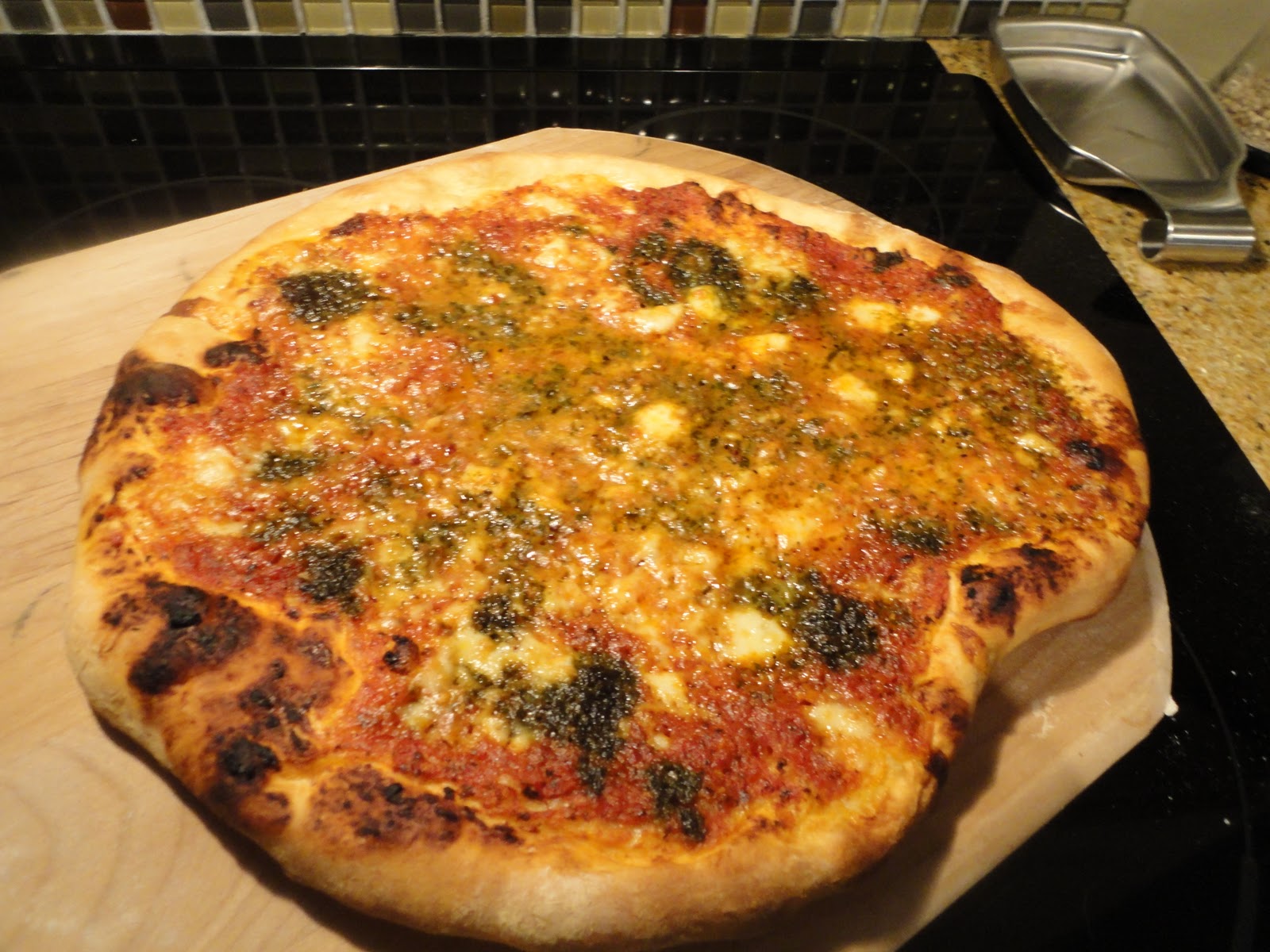
The toppings for this pizza were simple.  I found some fresh buffalo mozzeralla, so I used that, along with a little pesto I had in the freezer, and a bit of parmesan cheese.
toppings are limited, to let the crust really shine

On the buffalo mozzarella... well, for me, it wasn't worth the price tag.  Perhaps what I found wasn't a stellar example of the cheese, but I hardly tasted a difference between it and cow's milk mozzarella.  I will refrain in the future, unless someone convinces me that a different brand has a markedly different flavor profile.

Even in the wimpy 550 oven, the pizza browned and crisped beautifully.
a crisp crust, with a bit of char

So, in the end, I certainly think it was worth seeking out the Italian 00 flour, and I will continue to experiment with it.  I want to try making pasta with it.  Since it makes such a supple dough, I imagine it will make very silky pasta.

The big lesson here is to know your flours.  All purpose flour is great for a lot of things, such as popovers, cookies, and general use in the kitchen.  Very soft flours, like pastry flour and White Lily (a soft winter wheat flour available mainly in the South) are great for tender baked goods cut with fat, such as pie crusts, cakes, pancakes and biscuits.  Bread flour is good for bread, but I think it is too glutinous for pizza dough, and results in a tough crust.  

The more I cook, the bigger the variety of flours that find a home in my pantry.  Right now I have a little can of Wondra flour for thickening, white whole wheat flour (a variety of very light flour that looks much like white flour, but is whole grain -- love it for bread), Italian 00 flour, all purpose flour, corn flour, pastry flour, White Lily, rice flour, potato flour, and semolina flour.  I need a bigger pantry....

Wednesday, November 17, 2010

easy entertaining

Lasagna is a great dish to entertain with.  It can be assembled a day or two ahead, and while it bakes you can toss together a salad and make some garlic bread, and you have a clean kitchen, and plenty of time to relax with your guests.
The tomato sauce is a great place to add in
a variety of veggies

For the base sauce, I sauteed a couple of links of hot Italian sausage, and a couple of links of sweet Italian sausage, then drained away the fat, to prevent a greasy sauce.  I then add back just a tablespoon of the fat, and sauteed a variety of vegetables.  This time I used a leek, cut into julienne, a couple of shallots, sliced mushrooms, and julienned sweet red peppers.  Once the veggies were soft, and had given up most of their moisture, I added a cup of white wine, and cooked that until it had reduced by half.  Then I added a couple of tablespoons of tomato paste, two cans of whole fire roasted tomatoes crushed up, and the cooked sausage.  That mixture can simmer as little as 20 minutes.  In the mean time, I combined a large container of ricotta cheese, two cups of shredded parmesan (with an extra cup reserved for assembly),  a couple of teaspoons of freshly grated nutmeg, and two cups of fresh basil.
the ricotta mixture can be made in a food processor,
or simply combined by hand, cutting the basil into a chiffonade

Taste both the sauce and the ricotta, and adjust to your taste for both salt and pepper.  Grate a large ball of mozzarella cheese, and get ready for assembly.
Barilla's "no boil" lasagna sheets can go straight in the pan,
and cook up with a texture and appearance very
similar to home made pasta

Assembly is easy.  A couple of ladles of  the sauce go into the bottom of the pan, then a layer of noodles, a layer of ricotta, and a layer of mozzeralla.  Repeat twice, ending with a final layer of sauce, mozzarella, and the reserved parmesan.
just cover the finished lasagna with foil, 
and store it in the fridge

The lasagna takes about an hour to bake in a 350 oven, with the foil removed for the final 20 minutes.  It is done when the edges are bubbling, and the cheese is light golden brown.  Paired with a salad and crusty garlic bread, it makes a satisfying and hardy meal that is both easy and impressive.
the layers of savory sauce, noodles, and creamy cheese
make a delicious and simple meal with a minimum of clean up
before your guests arrive

Wednesday, September 29, 2010

gnocchi redux

On to the second style of gnocchi.  This time, ricotta and spinach gnocchi -- also known as gnudi, which literally means "naked" because they resemble the filling for a ravioli, without the pasta dough.  Research lead me to several different methods for making the gnocchi, and in the end, I combined a couple of different recipes, primarily one from Cook's Illustrated, and one from The Italian Cookng Encyclopedia.  From the ICE, I used the addition of spinach and multiple herbs.  From CI, I used the addition of toasted bread crumbs.  In the end, I used 16 ounces of ricotta, drained in a cheese-cloth-lined seive for a couple of hours in the fridge, a 9 ounce bag of spinach, half a cup of toasted bread crumbs, about 2/3 cup of flour, a cup of parmesan,  salt, pepper, grated nutmeg, a few leaves of basil, four cloves of garlic, and a handful of Italian parsley.  I tamed the harsh garlic bite by microwaving the four cloves for 15 seconds on high.
bread crumbs, parm, herbs and sweated garlic
go in a processor to be ground fine
The steamed, and thoroughly dry spinach are then added 
with an egg, and chopped fine

Once that is all combined, add in a couple of pinches of salt, a few grates of nutmeg, and a few grinds of pepper.  Combine that with the drained ricotta, and about 2/3 cup of flour.  Park that all in the fridge for at least 30 minutes.

My dough was still pretty wet, but I decided to roll it out in plenty of flour, rather than add more flour to the dough itself.  The decision paid off, in light, airy gnocchi.
ricotta and flour, incorporated by hand

The sticky dough is rolled into ropes, in plenty of flour
then cut into little squares and rested in a flour dusted tray

With all of that flavor in the dumplings, I decided on a simple tomato sauce, which I have talked about here before.  Just garlic, oil, tomato paste, tomatoes,salt and pepper.

Thankfully, the dumplings behaved just as they were supposed to, sinking to the bottom of a pan of simmering water, then floating to the surface after a couple of minutes.  I scooped them out, drained them on a towel, and nestled them on a pool of the sauce.  Garnished with a bit of parm and a sprinkling of fresh parsley, they were as pretty to look at as they were good to eat.

phase two of the gnocchi experiment