Showing posts with label pork. Show all posts

Monday, February 27, 2012

pan fired pork chops with greens and dressing

I've blogged about these thick-cut pork chops before, because Jim loves them, and they can vex me, trying to keep them succulent while still cooking them through.  I have stuffed them in the past with bread stuffing, or a combination of goat cheese, sun-dried tomatoes, and greens.  But I have decided that splitting them to make a pocket for filling increases the risk of drying them out before the filling comes up to temp.  So last week, I pan-fried them, and made rainbow chard and a dressing on the side.  I started with a brine of salt, honey, orange juice, and bay leaf in water.  I brined the chops for about 4 hours, then seared them off in one of my beloved mineral pans.
these pans really put a beautiful sear on foods--
I don't understand why they aren't in every kitchen

I made the dressing on the side.  My plan was to use celery, toasted pecans, apples, sage, fresh parsley, salt, pepper, an egg, chicken broth, and some old bread that needed to be used.  The veggies got sauteed in a bit of butter until they were just beginning to soften.  Then everything got tossed together with an egg and enough chicken broth to make a soft dressing.
mise en place was not en place--I forgot the apple

everything ready to go, but where's the apple?

no worries, I just diced a granny smith, sauteed it in a little butter,
and mixed it into the stuffing right in the pan


I had some rainbow chard in the fridge, as well as some mushrooms and shallots.  Sounded like a perfect side for a Southern pork chop dinner.
it probably doesn't get much more Southern than this,
though I didn't have any fatback in the greens

Sunday, January 22, 2012

wedding soup

Long a treat widely available up north and on the east coast, I assume because of the presence of Italian populations, wedding soup is something I haven't seen anywhere down south.  There are several different versions on various recipe websites, but I used to eat my favorite version in a dive restaurant in Erie, and I wanted to try to replicate, and improve on, the way they made it.
I started with the meatballs

I made a panade of a couple of slices of bread, some crushed fennel seeds, red pepper flakes, garlic, salt, and about a half a cup of milk, all ground up in the food processor.  To that I added some sweet Italian sausage, mixed it all up, and rolled little meatballs about three quarters of an inch in diameter. Someone asked me how I keep the size so consistent--a small melon baller and a cup of water. Scoop a dollop of meat in the melon baller, round the top, and dump the little meatball on the baking sheet. After about every third meatball, swish the melon baller in the water, washing away residue that can make the meatballs stick.
rolling the little meatballs was a bit tedious, but I 
knew I would have enough to freeze some for later

The meatballs baked in a 350 oven in about twenty minutes.  For aromatics, I sauteed diced onion, and carrots cut into matchsticks.   The carrots could just as easily been diced, but I like the look of the matchsticks, and I don't care for big bites of cooked carrot.  Besides, I have a handy little tool that shaves the matchsticks right off the carrot.  It looks like a vegetable peeler with teeth.
I lightly sauteed the vegetable in olive oil before adding the broth

Sauteing the veggies first is really just habit.  They could have just as easily been simmered in the broth--the soup cooks long enough for them to soften.  For broth I used my new favorite, outside of homemade stock--Swanson no salt-added cooking stock.  It has a clean flavor, and I love being able to control the salt level myself.    Along with the broth, I added about a cup of vermouth, and a boneless, skinless chicken breast, which I cooked at a bare simmer, and took out as soon as it hit an internal temperature of 165.  Chicken breast can get tough and dry if it is cooked too long.  It took about 20 minutes to cook through.  I took the breast out of the stock, added about two cups of water to the broth, and added in a half a cup of orzo pasta--the little pasta shaped like grains of rice.  Any small pasta shape would work.  The addition of water assures that the pasta won't soak up all the broth.  I brought the heat up to medium hi, and while the pasta cooked, I shredded the chicken breast to be stirred in at the last minute.  As soon as the pasta was al dente, I stirred in a full bag of arugula.
looks like a lot of greens, but they cook down a lot--
spinach would work, too, but I like the spicy bite in arugula

The greens cook in about two minutes.  After they cooked down I added about a third of my meatballs, and the shredded chicken.  I tasted for salt, added a bit, and served.
this is a pretty soup hearty enough to make a meal


Sunday, January 8, 2012

praise for the braise

A braise does three things, particularly for the lazy cook.  It provides a nearly hands-off cooking method, lends tenderness to sometimes finicky large cuts of meat, and it makes its own sauce.  Jim loves pork, but pork sometimes frustrates me.  Either it is too fatty or not fatty enough, depending on the cut.  And it can become dry and flavorless, if it is overcooked.   So I was intrigued when I saw Debbie Mazar's husband Gabriella cooking a pork loin braised in milk the other day on the cooking channel.  A little research lead me to believe that they may have fudged the results a little on the show, because the traditional pork braised in milk results in an odd curdled sauce that I suspect is an acquired taste.  But I haven't had anything resembling a milk gravy in years, so I thought I would take a whirl at making my own version, hoping for a result similar to what I saw on the show--a tender sliced pork roast with a creamy, silky sauce.

My first departure was the cut of meat, but that was just the product of a poor selection of roasts at the grocery store, and no desire to tack a trip to another store onto my errands.  The store had one pork loin roast, and one pork butt roast.  The butt roast was a bit smaller, and looked better, so it won.  The result would be that the meat wouldn't be as pretty when sliced, and there would be more fat to contend with in the sauce.
the pork roast needs a heavy coating of salt and pepper, 
best added about an hour ahead of time

The braise starts with some oil to brown the roast, along with some aromatics.  In this case I used sage and rosemary that are still hanging around in the garden (very mild winter here so far) along with a few cloves of garlic, skins and all.  The sauce gets strained, so there's no need to get fussy with the herbs.
nothing could be simpler than tossing whole herbs in a pot

browning the pork roast is not necessary, but it does add
flavor and color

Once the pork was browned off, I added a cup of white wine, a couple cups of chicken stock, and the lid.  Then the pot went into a 275 degree oven to be neglected for the next two or three hours.  About 30 minutes before we wanted to eat, I quartered some baby dutch yellow potatoes (my current favorite for grilling and pan frying), some onion, sweet baby bell peppers, and a yellow squash.  I browned the potatoes a bit first, then just added in the rest of the veggies along with some salt and pepper.
 my mineral pan is starting to look like a real cook uses it--
the uglier it gets, the more non-stick it gets

I pulled the roast out of the oven, put it on a board to rest while the veggies cooked, and strained the braising liquid into a gravy separator, a ten dollar tool that is unsurpassed at getting excess fat out of pan drippings.  I think I've had mine for twenty years or more.  Once I got rid of the excess fat, I put the pan dripping back in the pot, and over high heat to reduce them a bit.  I made a slurry of a couple of teaspoons of flour and a cup or so of whole milk, cut the heat off under the reduced drippings, and added the slurry to the pot, stirring it and letting it simmer in the residual heat of the cast iron roaster.  The result was a delicious silky sauce for the roast.  If you want to cut the calories, just reduce the defatted drippings and call it a day.
a yummy dinner with the side benefit of tender pork left over 
for sandwiches

Friday, November 18, 2011

tender pork chops

Keeping pork tender has gotten more complicated since breeders bred the fat out of pigs during the fat scare of the 80s caused pork sales to dwindle.  As a result, common cooking methods began to yield dry, tough meat that didn't taste of much.  I hate the lemming-like way people respond to public health scares.  There is nothing wrong with reducing the overall fat in your diet, but ruining the quality of a product is not the way to do it.  Nevertheless, I am stuck either figuring out ways to cook the rib chops that Jim loves, or spending a fortune on mail order heritage chops, and that is not going to happen any time soon.

When you don't have fat to help retain moisture in meat, then salt makes a pretty good substitute.  As does buying chops on the bone, which helps protect the meat from high temperatures.  With bone-in chops, I like to "dry brine", which consists of liberally salting the chops on both sides and letting them rest on the counter for about an hour.
osmosis first draws water out of the chops, then
draws it back in where the salt both flavors the meat and 
helps retain the moisture during cooking


After the chops have been brined for an hour, excess salt can just be dabbed away before cooking.  Earlier this year I tried a Cook's Illustrated technique that recommended cooking the chops low and slow, and searing them off at the end to get color.  I couldn't detect any difference, so I am back to browning first, then building a sauce right in the pan and simmering the chops over low heat until they are done.  Being careful not to overcook chops is the second trick for keeping the meat moist and tender.  Chops are done at 145 degrees, and perfectly safe to eat when there is still the barest hint of pink in the meat.
a light golden sear is all that is necessary when the chops
are going to be simmered in a dark sauce


For this preparation, I started with mushrooms, sliced shallots, minced garlic, Madeira, and a demiglace.  If you don't have demiglace, beef or chicken broth will work fine.  I love these little packets of demiglace because they add wonderful body to sauces, don't take up much room in the pantry, and once they are opened, they freeze wonderfully.  I use the veal, chicken, mushroom, and seafood.
yes, I was going to add broccoli to this dish, and no,
it didn't make it in--I found it the next morning in a bowl in
the microwave, where I was going to blanch it before I added it to the sauce

After searing the chops, I removed them from the pan, added a small knob of butter, and sauteed the mushrooms and shallots until they gave up some of their moisture and began to brown.  Then I added the minced garlic for about 30 seconds, just to release its fragrance.  Garlic is very easy to burn.  I then added about a half a teaspoon of thyme and deglazed the pan with about a half a cup of the Madeira, which adds a fantastic flavor to sauces.  I then added a cup or so of water, and a spoonful of the demiglace.
mushrooms take about 5 minutes over medium heat to 
release their moisture and begin to brown


once the sauce is built, the chops go back in and 
simmer over low heat for about 20 minutes

An instant-read thermometer is a great way to make sure the chops don't go above 145 degrees.  Since this is a heart dish, I thought it would pair nicely with whole wheat noodles, but mashed potatoes would be great, too.
the chops, garnished with some sliced green onion,
were tender and moist
Wish I had gotten the broccoli in there, but it was out of sight, and I was out of my mind to put it in the microwave before I was ready to cook it.

Monday, May 9, 2011

variation on a theme

We have collard greens in the garden.  Oh, my, but do we have collard greens.  Jim is dousing everything in the garden (and all the flowers) with Miracle Grow, and everything is responding with out-size growth.  So, last night, I decided to do a spaetzle and mushroom dish we love, but this time with the addition of collards.
we grilled a bone-in pork roast on the rotisserie

The nice thing about combining pasta (or its cousin, spaetzle) with veggies is that you cook a bit of starch and a variety of veggies all in the same pan.  Speaking of pans, I am every day more in love with my new French iron pans.  They really are super non-stick, gorgeous to look at and easy to clean.  Now, I promise to stop mentioning them. 
I started with a simple saute of sliced mushrooms and shallots in a bit of butter

After the shallots and mushrooms had wilted and begun to color, I added a bit of concentrated veal stock, which I find to be richer, and actually more convenient, than beef broth, along with a couple of cups of the water and the dried spaetzle.  I use dried spaetzle in this case because of the way it soaks up the flavors of the sauce.  Fresh spaetzle could not take on so much flavor because the dough would become too soft in the rich broth.  Once the spaetzle had nearly cooked through (just taste it, it takes about 15 minutes) I began adding in the collards, along with a bit of grated nutmeg, salt, and pepper.  Nutmeg is a natural partner with greens.  Its warm flavor plays off nicely against the bitterness in the greens.
the collards need to cook only until they are tender

The dish was a happy marriage with the grilled pork, easy to prepare in one pan, and interesting to eat -- warm, slightly bitter, and rich with contrasting vegetal flavors.

Friday, April 22, 2011

the curse of leftover ham

Easter is fast approaching, and with it comes the inevitable curse of leftover ham.  That is, if you are a traditionalist, and serve ham for dinner.  I am, and I bought the smallest ham I could find at WF, which weighs in at just under ten pounds.  With just Jim, my mom, and me that is A LOT of ham.  I don't know about you, but I can eat only so many ham sandwiches.  So last night, I sliced off a bit of the ham in anticipation, and made a hash.

Hash is a great way to use leftovers, and a good way to get a variety of vegetables into your diet.
for my hash, I used hot red pepper, leek, sweet bell pepper,
and fresh Vidalia onion

I started the veggies along with diced ham, in a couple of tablespoons of peanut oil shimmering over a medium burner. I was cooking them in a new 14-inch cast iron French pan.  Yes, I loved the 10-inch one so much, that I bought a larger version.  The pic on Amazon doesn't show it, but the 14-inch titan has a very nice "helper" handle on the side opposite the main handle.  It is a monster, and it is gorgeous.  With cast iron, you really never need to go much over a medium heat.  Once the veggies and ham had started to brown, I added a couple of cups of shredded potatoes and started heating some water, with a couple of teaspoons of salt and a couple of tablespoons of vinegar.  The vinegar help poached eggs to stay together in nice, tight little orbs.  It also helps if you have very fresh eggs.   I brought the water just up to a slow simmer.
poaching eggs is a really easy and healthy way to cook the wonder orbs

Poached eggs are done in about 4 minutes, but you can hold them for a long time in cool water, then just drop them into simmering water for a minute to heat them up.  They are done when the white is completely cooked, and the yolk is still soft to the touch.

I added salt and pepper to the hash,then spooned a cup of the hash in the center of the plate, and added a poached egg.  I added a bit of salt and pepper to the egg, garnished with a bit of chopped parsley, and dinner was served.
a pretty, simple way to use leftover Easter ham
the new pan in action -- I decommissioned several old pans when this baby arrived

Thursday, March 24, 2011

STUFFFED

Jim really loves big, fat pork chops.  And since I have been working some evenings he has been buying a few.  I had one left in the fridge, which meant just not quite enough for two, and way more than one person needs to consume.  So that lead to a stuffed chop.  I had on hand goat cheese, frozen spinach, and sun dried tomatoes.  Coupled with a little garlic, that made for a classic stuffing.
a quick saute with some olive oil married the ingredients together

Frozen spinach actually has an advantage over fresh in this sort of application.  The spinach can simply be thawed, and wrung dry of all its excess moisture.  Spinach has a lot of excess moisture.  Just wring it out like a dish cloth. 
Once the garlic was light golden and the tomatoes were soft, I added a third of a cup of goat cheese, off the heat, and stuffed it all into a pocket cut in the chop.
a few minutes in a saute pan and 15 minutes in the oven cooked this monster

The stuffing brings moisture and interesting flavors to the chop.  I served it with some baby potatoes sauteed with onions and chipotle peppers.
why are my pics all blurry all of the sudden?  

I've been frustrated lately with my photography.  Time for a new camera, and some lessons on using it....

Friday, October 15, 2010

a little schnitzel and potato salad for Oktoberfest

Oktoberfest is a big celebration for Germans, and since I am half German, and know very little about German food, I thought that was a good reason to do a little research.  A schnitzel is really about a style of cooking meat, and it doesn't really matter if it is veal, pork, chicken, or even wild game.  The Austrians tend to use veal, the Germans, pork.  So I decided to give it a go with some boneless pork loin chops.

I started by arranging the chops on a plastic cutting board (one I use only for raw meat, because it can go in the dishwasher,) covering them with a little plastic wrap, and whacking away at them with a meat pounder.  A sturdy rolling pin or a heavy pan would work as well.  One of the key elements of a schnitzel is using a very thin piece of meat.  I went for about a quarter of an inch thickness.  Next time I make it, I will go even thinner, because I discovered that the meat shrinks back up a bit as it cooks.
pounding the meat thin makes for faster cooking
and moister meat

The cooking part is really very simple.  Season the meat with salt and pepper and set it aside.  Line up three dinner plates on the counter.  In the first one, put about a cup of flour for four cutlets -- more if you are making more chops, less if you are making fewer.  In the second plate, break a couple of eggs and add a tablespoon of milk.  Whisk that together.  In the third plate, put breadcrumbs.  I used panko breadcrumbs, which is hardly authentic, but I like their ease of use and the way they get super crispy, but any fine, dry crumbs will do.  Simply dip the cutlets in the flour, then the eggs, and finally the bread crumbs, shaking off any excess, and pressing on the crumbs to adhere them firmly to the meat.  Setting the coated chops aside for a few minutes to allow the crumbs to set a little is a good idea.  I set them on a wire rack.

Heat a couple of tablespoons of butter and a couple of tablespoons of vegetable oil in a large frying pan over medium heat.  The butter will add flavor to the breading, and the oil raises the smoke point of the butter, so you can cook at a little higher temperature.  You want the chops to sizzle as soon as they hit the pan.  An easy way to make sure the pan is hot enough is to test a few breadcrumbs in the oil before you add the cutlets.  Schnitzel will cook in about two minutes on each side.  You want them nice and golden brown, but not overcooked.  Overcooked pork can be very dry -- particularly the loin, which is very low fat.

To add complexity to a very simple dish, I wanted a good German potato salad, which I had made before.  I prefer it to a mayonnaise based potato salad for its lightness and its vinegar tang.  I used little baby dutch yellow potatoes, just because I like their flavor and firmness, and their quick cooking time.  Any boiling potato will work, but baking potatoes are too crumbly for this salad.  The vegetables used in the potato salad vary among recipes, so I suggest using whatever you prefer, though a bit of onion is always in order.  I had a pretty little red bell pepper from the garden, a serrano pepper, and a bunch of green onions.  Perfect.
whatever vegetables you use, mince them fairly small

While the potatoes boil (or cook in the microwave, whichever method you prefer), slice two or three strips of bacon into quarter inch strips, and fry over medium low heat until crisp.  Remove the bacon from the pan, and add the vegetables to the bacon fat, cooking just until tender.
the vegetables are cooked just to tender crisp
so they retain a bit of body and a nice bright color

Once the vegetables are done, add a third of a cup of vinegar, and simmer to reduce a bit.  I used white balsamic vinegar.  I like its nice aroma and mellow flavor, but white wine vinegar or apple cider vinegar will work as well.  Avoid red or dark vinegars, which will stain the potatoes with an unappealing color.  Add in a teaspoon or so of salt, some freshly ground pepper, and some mustard seeds, or coarsely ground mustard seeds.  Slice the cooked potatoes into little rounds as soon as you can handle them.  You want them as hot as possible.  Add the dressing to the warm potatoes, throw in the crisp bacon, and add a handful of fresh herbs for brightness.  I had parsley and chives on hand, so that's what I used.
herbs add to the spicy aroma of the warm salad

The spicy warm salad was a great foil for the crunchy but simply prepared pork.  
a simple October dinner, ready in about 30 minutes
next time, I will pound the pork even thinner

Saturday, September 18, 2010

fall is for apples

Apples are a bit of a miracle fruit, with their crisp white flesh and their ability to store for long periods, but they are never better than they are in the fall.  And I especially enjoy them in savory dishes.  Which for me, usually means pork, because pork and apples are quite fond of hanging out together.  Last night, that meant that some bone-in pork chops were destined to meet up with some apple/sage dressing.  The dressing couldn't be easier.  For four pork chops, you start with one large apple, cored and cut into chunks, half a large onion, and a couple of stalks of celery, with the leaves on, if they are still there .  Fairly firm, sweet/tart apples are the best choice to include in a dressing.  Some good choices are Duchess, Cortland , McIntosh, Jazz, or even Granny Smith.
mise en place for the dressing -- chopped fresh sage, 
celery, onion, apple, and toasted bread

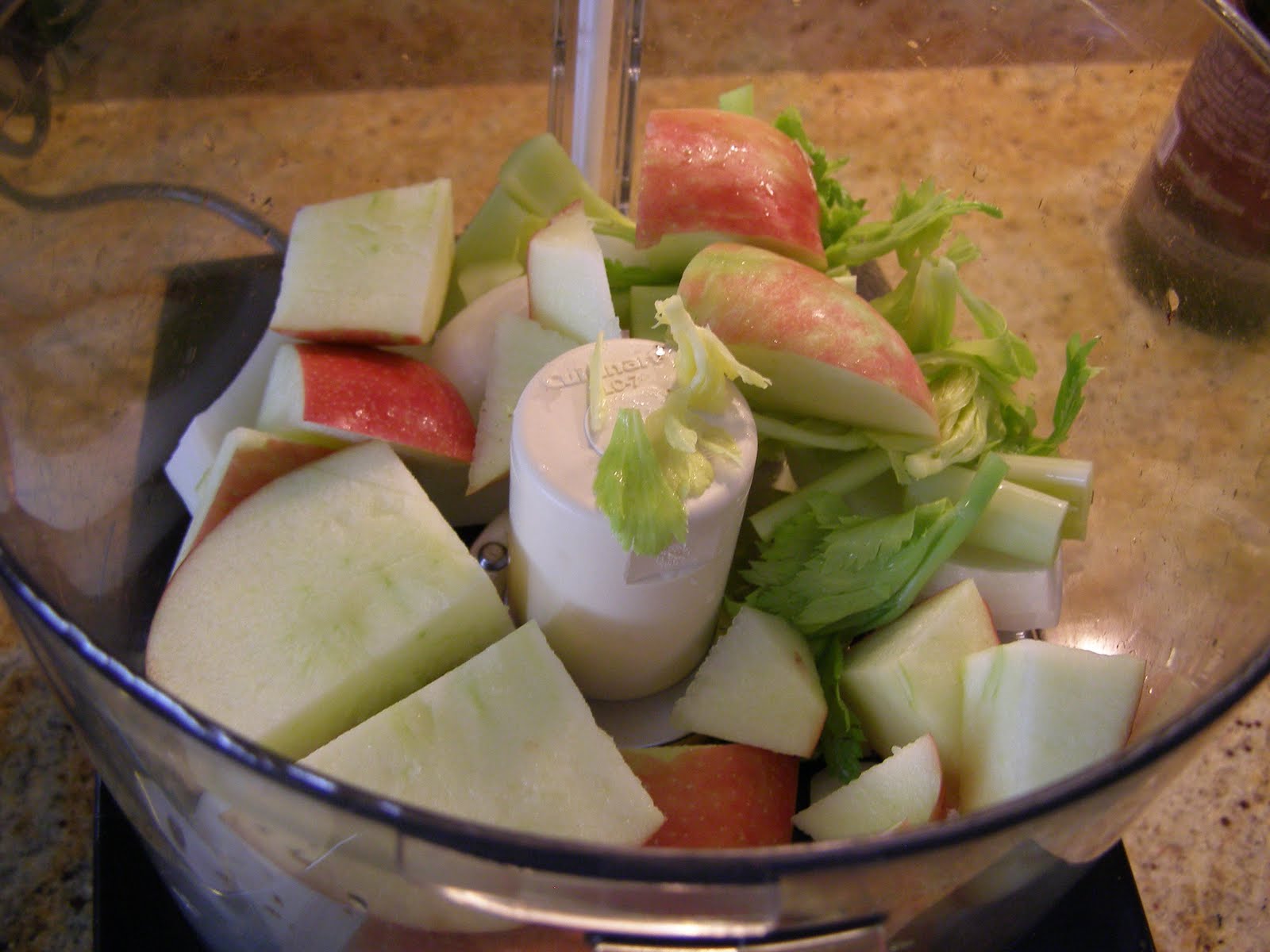
I had fresh sage in the garden, but if you don't have fresh sage, dried will do nicely.  The onion, apple, and celery need to be chopped.  A food processor will make quick work of that.
everything can just be cut into chunks and tossed in--
after a few pulses, you'll have a nice base of veggies
for your dressing

That mixture gets sauteed in  a couple tablespoons of butter, until it gives up a good bit of its moisture, and begins to color, just a bit.
veggie goodness

For the bread element of the dressing, I prefer a fairly hardy white bread, such as a boule, or french or italian loaf.  For four pork chops, use about three cups of cubed bread.  I toast the slices lightly, and leave the crusts on, because I like the slightly hardier texture of the crust -- if you don't, simply trim off the crusts before cubing the bread.  After the veggies are sauteed, the cubed, toasted bread can be stirred in, as well as a couple of tablespoons of fresh sage (or about half that much dried sage), and salt and pepper to taste.  Once the mixture has cooled, add an egg to bind, and moisten with chicken broth if it seems a little dry.  I like, at this point, to toss in a handful of chopped, toasted pecan pieces, but that is certainly optional.
cut a pocket in fat, bone-in chops, or sandwich the dressing
between two thinner chops

Once the chops are stuffed, brown them lightly on top of the stove, and slide them into a 350 oven for about twenty minutes to finish cooking.  The stuffing should reach an internal temperature of 165 degrees.  A quick pan sauce can be made with the drippings by adding a bit of chicken broth, maybe a bit of wine, and reducing by half, then stirring in a last minute tablespoon of butter, off the heat.
apple/sage stuffed chop with a side of sauteed veggies

Don't feel like going to all the trouble of making a dressing and stuffing the chops?  Then just slice up your apples and an onion, and saute them in the pan, right along with the pork chops.  set aside the meat and apple mixture, and make a pan sauce by reducing chicken broth.  A dollop of brandy and a spoonful of sour cream make a wonderful last minute addition for a very special sauce for a wonderful fall dish.


Here comes that mandolin again.  Last night, to accompany the chops, I used a mandolin to slice thin ribbons of zucchini, onion, and sweet red pepper.
the mandolin  makes particularly pretty ribbons 
of vegetable

Sauteed together in a knob of butter, with salt, pepper, lemon zest, and lemon juice, the fine ribbons of vegetables make a very pretty side dish.


Wednesday, September 15, 2010

meatball nirvana

Meatballs are a staple at our house.  Jim is a spaghetti carnivore, and I don't care for the texture of ground beef in spaghetti sauce.  So meatballs are the perfect solution, and I wanted a way to make the perfect meatball.  There are thousands of recipes out there, but after a little fiddling I found the combination that we like the best.  I have found that a very soft combination of meats, seasonings, spices, bread and milk make for a very tender meatball.

I use only pork for meatballs -- usually a combination of sweet and hot Italian sausage if I am not grinding my own meat.  Additionally, I add fennel seeds, red pepper flakes, and dried minced garlic; toasted and ground coursley in the spice grinder.  I also add dried shallots, salt, and pepper.  I find the dried garlic and shallot add a more subtle flavor to the meat than fresh.  If you can't find dried shallots, dried minced onion would work just fine.  I love Victoria Taylor dried shallots, and often find them in the gourmet foods at TJ Maxx. In the food processor I put two hardy slices of peasant bread and about a half a cup of milk and grind it to make a soft bread paste called a panade. 
panade  -- here made with cream instead of milk, 
because I had some on hand -- decadent!
To that, I add the spices, the meat, and about a cup of shredded Parmesan, and grind it to combine.  The result is a soft mixture that can be a little difficult to handle, but it results in a very tender meatball.  I do not add egg because, though it does help bind the meat, I think it slightly toughens the cooked meatball.  Because they are very soft, I have found it to be much easier to bake them instead of trying to brown them in a frying pan.  When forming the meatballs, wetting your hands down every couple of meatballs really helps keep the meat from sticking to your hands.
we like large meatballs, just slightly smaller than a tennis ball

Twenty minutes or so in a 450 degree oven will give you nice browned meatballs.  Baking them on a broiling pan allows some of the excess fat to drain away.
golden brown meatballs

For the sauce, I make a basic tomato sauce, which is sliced garlic that has been poached in olive oil until it is just barely golden, tomato paste, diced tomatoes, a pinch of red pepper flakes, salt and pepper.  I often have a store of that sitting in the freezer.  For spaghetti and meatballs, I usually add quartered crimini mushrooms, sauteed with minced shallot and sometimes a bit of red bell pepper; another big pinch of red pepper flakes, and a couple big pinches of oregano.
the browned meatballs are submerged in the sauce,
and everything is simmered together for 20 minutes or so

The result is a very hardy meal when served with a green salad and maybe a thin slice of garlic toast.  I have found a lower carb pasta I like called Dreamfields that is much lower in carbs and higher in fiber than traditional pasta, but still tastes like the real thing.  If you run across it in the grocery store, give it a try.
the end result garnished with shaved parm -- Jim's portion -- my portion was a 
bit more modest in size...

As you can see, I made quite a bit of sauce and several meatballs.  This freezes very well, and will heat up in the microwave in the time it takes to boil pasta.  Reheat on a lower heat to avoid exploding meatballs in your microwave.

Saturday, June 26, 2010

feeding a craving

Last night, I had an irresistible urge for some nachos.  An unreasonable urge that wasn't going to take no for an answer.  But I want to prepare a reasonably healthy version that could take on the title of "dinner".  That made me think first of the chips.  I certainly wouldn't classify salty, fatty, bagged tortilla chips as a wise dinner choice.  And I really didn't feel like making my own corn tortillas, as easy as they are.  (Just being lazy I guess.)  That made me think of some unusual tortillas I had spotted at the local grocery.  A sort of hybrid flour/corn tortilla that had a much nicer, softer feel than the usual cardboard-consistency grocery store tortillas.

these new hybrids have a great corn flavor, 
and are made with whole grain

Cut into quarters, and spritzed with a little peanut oil, then baked in a 400 degree oven for about twenty minutes, and these made some crispy, and healthy chips to build into nachos.

I had a couple of jalapenos as well as a banana pepper in the garden, so I sliced those up along with a thinly sliced clove of garlic, and tossed them with some vinegar, salt, a little sugar, and water to make a quick and tasty pickled pepper mix.  Guacamole came together in minutes with a few small diced onions, a diced jalapeno, lime juice, salt, and an avacado.

 a fresh guacamole and a few pickled veggies

Ater letting them sit for a couple of hours.  I took half of them and mashed them in with some drained black beans.  In the freezer, I found a little left over Carne Adovada, so these were going to be pork nachos.  But a little shredded chicken or some hamburger sauted with some onion and chile powder would work just fine, too.  I grated a little cheddar and some pepper jack, and I was ready to assemble.  On each chip, I put about a teaspoon of the black beans, a little chunk of the shredded pork, and a teaspoon of the cheese.

nachos, ready to go under a low broiler

Ten to fifteen minutes under the broiler gave the chips a nice, crunchy texture and melted the cheese to a creamy consistency.  Now, to make it a real meal.  I sliced up some crunchy lettuce, diced tomatoes, and chopped a little cilantro to go on top, along with a little squirt of sour cream.  Served with a tomato salsa (I dress up a jar of Herdez salsa with a little green onion, cilantro, and jalapeno), the guacamole, and the rest of the lightly pickled veggies, it made for a fun dinner with a little bit of a pub vibe, without all the excessive salt and fat.

nachos, with accompaniments, fun,
especially with a cold corona with a squeeze of lime


Some of you may have noticed that I have been MIA for a bit.  Everything is fine -- just got a little distracted by work, but I am back on track now.